UN3373 Packaging for Clinical Trial Transport
Pharmaceutical laboratories, healthcare facilities, diagnostic laboratories and research centres ship thousands of samples originating from human or animal sources worldwide every day. The results of these medical analyses, clinical trials, surveillance studies and others are crucial in the marketing authorisation (MA) dossier of a treatment. Scientific research requires shipping solutions that meet these challenges.
Transporting clinical trials: what does the regulations say?
Samples have to be transported in accordance with IATA regulations (for the air transport of dangerous goods) or the European Agreement concerning the International Carriage of Dangerous Goods by Road (ADR). These regulations pertain to the air or road transport of infectious materials that may contain pathogens. They are based on UN recommendations.
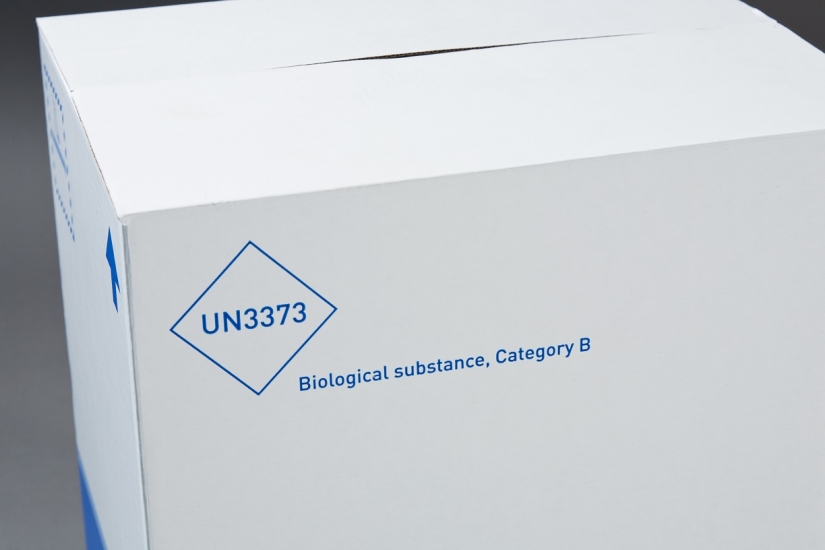
Infectious material, Category A, assigned to UN Nos. 2814 and 2900, is that which can cause permanent disability or a fatal disease in humans or animals. Infectious material, Category B, is that which is not classified in Category A. Assigned to UN No. 3373, its official transport designation is “BIOLOGICAL SUBSTANCE, CATEGORY B.”
UN3373 packaging according to the regulations
UN3373 packaging consists of three layers:
- A leak-proof primary packaging (container) that holds the material.
- A secondary sturdy and leak-proof, packaging that protects one or more primary containers wrapped in sufficient absorbent material to absorb any liquid in case of leakage.
- An outer packaging that protects its contents and ensures, if necessary, the cold chain.
Each primary container must not exceed 1 litre for liquids or 1 kg for solids. The maximum quantity of Category B biological material transported in a package is 4 litres or 4 kg. The package must be properly marked, labelled and accompanied by transport documents.
Temperature-controlled packaging is essential for temperature-sensitive samples. Temperature-sensitive samples have to be transported in strict compliance with the cold chain, as their effectiveness depends on it. Depending on their stability, they are transported between +2 and +8 °C (or even between +2 °C and +4 °C) or below -18 °C.
Laboratories, depots and CRO hubs use insulated packaging. During home treatment, certified insulated bags are used to transport the product. For returns, samples (blood, skin, etc.) are transported in UN3373 insulated packaging from the collection site (hospital or laboratory) to the analysis laboratories.
Certified UN3373 insulated packaging by Sofrigam
Sofrigam has developed a range of UN3373 packaging ensuring the safe transport of clinical test materials.
The Clinibox® packaging range ensures the safe transport of temperature-controlled clinical tests (clinical samples, diagnostic samples, or biological material, Category B).
It guarantees compliance with current regulations for the transport of dangerous goods (IATA and ADR) and maintains the cold chain. The insulated packaging is tested and certified by our partner, the Ater Métrologie laboratory, under the ISTA 7E profile for thermal performance and a minimum drop height of 1.2 m.
These UN3373 transport kits consist of VIAL 650 pouches and an insulated box. The VIAL 650 pouch (secondary packaging) is certified 95 kPa by an IATA-approved laboratory.
It is divided into several separate compartments that contain sufficient absorbent material and in which the tubes are directly placed. It thus meets the requirements for tube separation and protection against spills. As for the insulated box (outer packaging), this is made from rigid polyurethane panels, cooled with eutectic gel plates.
The standard range includes:
- The Clinibox 06/40 to maintain 1 to 5 tubes between +2 and +8 °C for 36 hours,
- The Clinibox 05/40 to maintain 1 to 5 tubes below -18 °C for 24 hours,
- The Clinibox 21/60 to maintain up to 25 tubes (5 pouches) below -18 °C for 72 hours.
The references 05/40 and 21/60 are also available with dry ice for a duration of up to 96 hours.
These UN3373 packages can be custom-made according to your logistical constraints.