Design of a labelled cooling pouch for the transport of medicines
The last step of the distribution circuit, often managed by the patient, remains difficult to control; it is the weak link in the cold chain. What happens when the patient leaves the pharmacy with their vaccine to return home or go to the doctor’s office? How do they carry the vaccine? And most importantly, has the product retained all the required qualities at the time of administration? These questions, and especially the answers provided by users, allow for an initial risk analysis of this link and the development of an appropriate insulated solution. Explanations.
Ensuring Temperature Maintenance Throughout the Logistics Chain
The various stakeholders in the medication logistics chain (pharmaceutical laboratories, regulatory bodies, distributors, pharmacists, logistics providers, solution suppliers, etc.) are making significant efforts to ensure the maintenance of the cold chain throughout the logistics process, up to the administration of the medication to the patient.
Numerous measures are implemented to preserve the therapeutic qualities of the medication to be administered to the patient. The storage and transport conditions are relatively controlled from the manufacturing of the product until its arrival at the pharmacy, passing through wholesalers and distributors.
However, the distribution chain does not end at this point. Indeed, the last step before the administration of the product (pharmacy > home, home > clinic, etc.) is the weak link in the chain as it is often under the responsibility of the patient and falls outside the direct control of professionals.
Insulated bags are used by patients to keep temperature-sensitive products between the pharmacy and their home or between home and the doctor’s office. A study conducted by Cemafroid* showed that these bags are not effective and are not suitable for maintaining temperature-sensitive medications between +2 °C and +8 °C.
The Medication: A Product with Very Low Thermal Inertia
Medication is a product with low thermal inertia, often less than 10% that of water. Its temperature varies rapidly depending on the environment in which it is located.
A vaccine can exit the required temperature range within a few minutes when exposed, without protection, to heat or cold. Following these variations, some products may degrade or lose their effectiveness.
Comparative Test: Temperature Rise of a Vaccine and a Water Bag
A comparative test of temperature rise is conducted on a vaccine and a small water bag. The vaccine is presented in a glass vial containing 1.5g of liquid and placed in a cardboard case. The plastic bag contains 25g of water. A probe measuring the temperature of the vaccine is placed on the glass vial inside the case. A probe is wrapped around the water bag to measure its temperature. The vaccine and the instrumented water bag are stabilized at +5 °C and then placed in an environment at +21 °C (±1 °C).
The temperature of the vaccine rises quickly and exceeds +8 °C after 3 minutes, reaching +15 °C after 12 minutes. The temperature of the water bag exceeds the +8 °C limit after 3 minutes and reaches +10 °C after 12 minutes.
The difference is explained by the disparity in thermal inertia between the two products. The result, presented in the curve below, shows the inevitable break in the cold chain if the vaccine is exposed without protection to heat or cold.
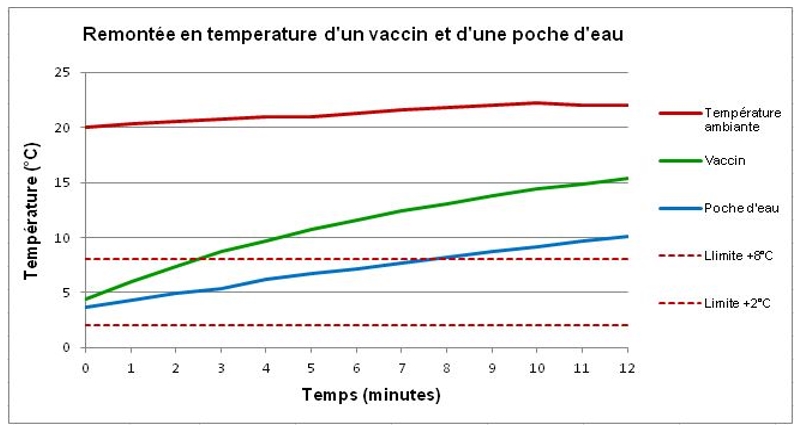
Temperature Rise of a Vaccine and a Water Bag at +21°C (±1°C)
Traditional Insulated Solutions Do Not Meet Needs
The solutions typically offered are so-called insulated bags, either alone or combined with unsuitable eutectic plates. The arrangement of the products and the cold source varies depending on the size of the products and that of the bag.
Having very thin walls and a relatively large exchange surface, the bag alone without additional thermal inertia does not protect the product, regardless of the quality of the insulating material. The use of an unsuitable eutectic plate does not significantly and reproducibly improve these performances. Such a plate only covers part of the product and can also deform the bag and prevent it from closing.
According to the study conducted by Cemafroid, the classic bags used by patients are ineffective. Tests have been conducted on various bags to verify the duration of maintaining a medication between +2 and +8 °C under an external temperature of +15 °C.
- The duration does not exceed 5 minutes for bags equipped with thermal inertia and stabilizing the entire setup at +5 °C.
- It does not exceed 3 minutes for bags without thermal inertia stabilized at +5 °C.
- The duration is negligible for pre-conditioned bags at room temperature.
The Igloo° Concept
Sofrigam has developed the Igloo° insulated bag, intended for patients and hospitals to transport small products over short distances. It is a medication protection kit equipped with a flexible eutectic plate to be pre-conditioned at +5 °C. It is an effective and simple-to-use mono-configuration solution, with a single preparation mode for all seasons. The Igloo° bag maintains the product between +2 °C and +8 °C for at least 1 hour. Reusable at least 50 times, it secures the weak link in the cold chain, from the pharmacy to the home, at a reduced price and within the reach of the patient.
A Specification Document Established with Pharmacists
A specification document has been established in collaboration with stakeholders in the medication distribution chain. Pharmacists and representatives from pharmaceutical laboratories, wholesalers, hospitals, and pharmacies have been consulted. The discussions allowed for consideration of the constraints and requirements expressed and to address the shortcomings and disadvantages of existing bags. The sought solution is intended for patients and hospitals to transport small products over short distances. It must be effective, reusable, and adapted to the pre-conditioning means available in pharmacies and at an affordable price. The main elements of the specification are as follows:
- Maintaining the product between +2 and +8 °C for at least 20 minutes, in summer and winter;
- Homogeneity of temperature in the useful space occupied by the product;
- Mono-configuration with the same simple operating mode for all seasons;
- Reusable and having reduced size and weight;
- Acceptable price.
Description of the Bag
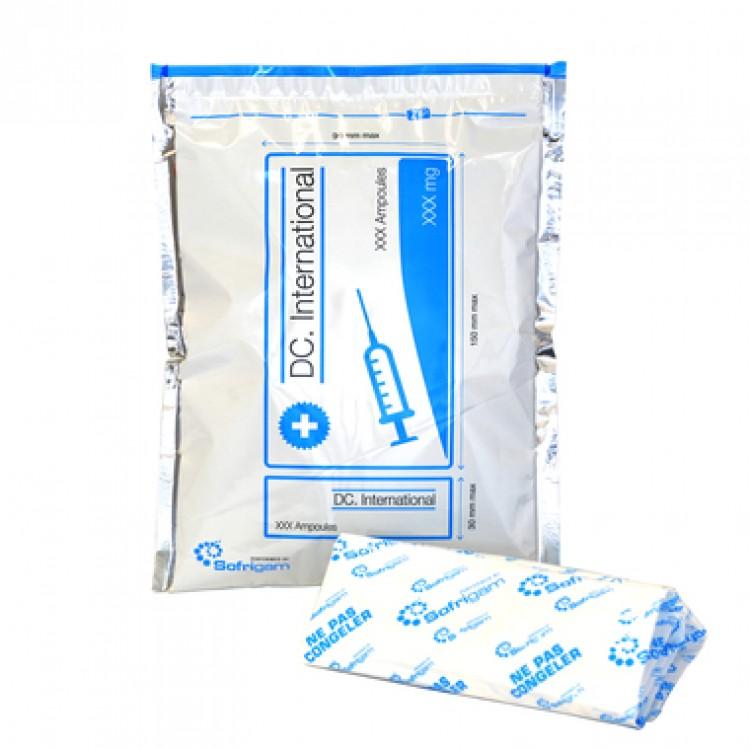
The Igloo° kit consists of an insulated bag with a zip closure and a flexible eutectic gel plate. The bag is made by welding three plastic materials together. Two films sandwich a soft polyurethane foam.
- The outer film is a complex of corona-treated polyethylene terephthalate (PET), corona-treated metallized PET, and low-density polyethylene (LDPE);
- The insulator is a soft polyurethane foam;
- The interior is a white LDPE film suitable for food contact.
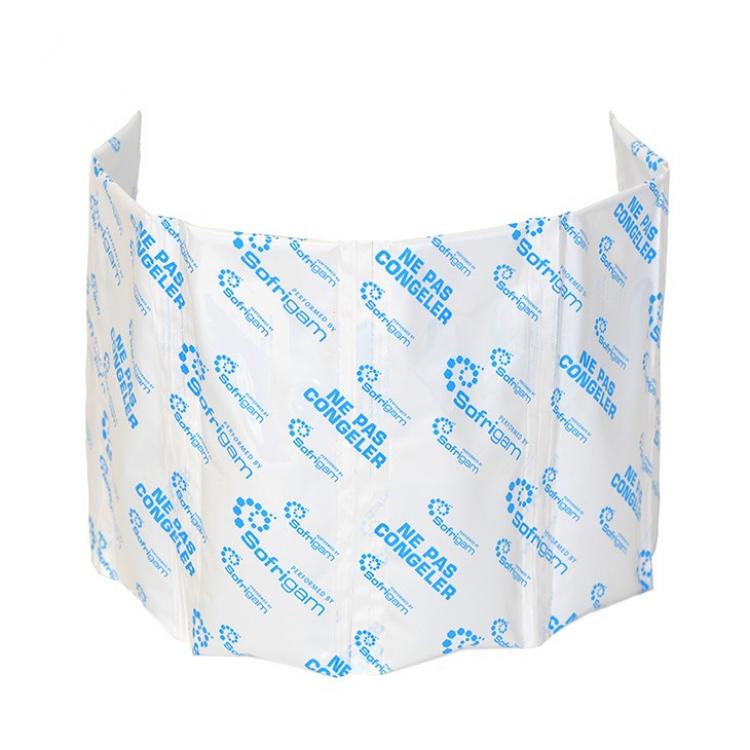
- The flexible eutectic plate consists of 6 doses of gel packaged in plastic film pouches.
The usage instructions are printed on the bag.
The independent Certicold marking is affixed to the bag.
The bag has external dimensions of 260 x 200 x 25 mm with a total weight, including the eutectic plate, of 277 g.
A Qualified and Certified Insulated Solution
Igloo° has undergone thermal performance qualification by the Ater Métrologie laboratory and Certicold Pharma certification by Cemafroid (Certificate No.: CTCPE-FR-002-002). It allows the product to be maintained between +2 and +8 °C for at least 1 hour. The test results are reproducible and confirmed by the certifying laboratory. Two patents have been filed for the concept and for the brand.
Conclusion
The Igloo° insulated bag is designed for patients and hospitals to transport small products over short distances. It is a medication protection kit equipped with a flexible eutectic plate to be pre-conditioned at +5 °C. It is an effective and simple-to-use mono-configuration solution, with a single preparation mode for all seasons. The Igloo bag maintains the product between +2 °C and +8 °C for at least 1 hour. Reusable at least 50 times, it secures the weak link in the cold chain, from the pharmacy to the home, at a reduced price and within the reach of the patient.