Stabilisation Protocols for Eutectic Plates

The preparation of eutectic plates used in isothermal packaging is a crucial step in securing the cold chain for health products. Depending on the nature of the products and the temperature profile, these thermal accumulators have to be stabilised and inserted into packaging solutions at a predefined temperature. In this article, we analyse the two operational modes for preparing eutectic plates.
Properties and Preparation Method of Eutectic Plates
Properties of Aqueous Eutectic Solutions
The eutectic solution compensates for the heat exchanged between the inside and outside of the isothermal box and replaces the need for an external energy source.
With a high latent heat (334 kJ/kg), which is non-toxic, non-flammable and economical, aqueous eutectic solutions are the most commonly used in isothermal packaging. Compared to other phase change materials, the 0 °C water-based solutions are the most widely utilised for the +2/+8 °C range under warm temperature profiles (> +15 °C).
The performance of eutectic solutions is enhanced by presenting them in gel form through the addition of thickening agents. The viscosity suppresses or reduces convection and slows down melting, allowing for a longer restitution time compared to water.
The amount of thermal accumulators to be placed in an isothermal packaging solution depends on several factors. The main parameters are:
- the thermal storage capacity of the eutectic solution used;
- the overall heat transfer coefficient K of the isothermal box;
- the profile of the outside temperature and the duration of the logistics circuit;
- the requirements of the product to be transported.
Methods for Preparing Eutectic Plates
Let’s take the example of 0 °C eutectic plates. They are used as thermal accumulators in isothermal boxes to keep temperature-sensitive health products between +2 °C and +8 °C.
Before being inserted into the packaging, these eutectic plates are generally frozen in standard equipment at around -20 °C and then stabilised or brought up to a temperature close to their melting point (around -2 °C). Conducted according to a certified protocol, this operation allows the use of the latent phase of the eutectic solution while preventing the transported products from dropping below the lower limit of +2 °C.
The operational mode applied to reach this temperature depends on the available means and the quantity of thermal accumulators to be prepared. They can be stabilised at -2 °C by storage in a second chamber or, in the absence of such equipment, left at room temperature for a period allowing their temperature to rise.
Impacts of the Insertion Temperature of Eutectic Plates in Isothermal Packaging
Thermal Performance Tests of Eutectic Plates with and without Stabilisation
To study the impact of the insertion temperature of eutectic plates, thermal performance tests were conducted on the same isothermal box with plates inserted at -20 °C and at -2 °C. These tests were carried out according to a protocol specifying the conditions and metrological requirements.
Test Protocol :
Tested box: An isothermal box made of 60 mm thick polyurethane panels, with an internal volume of 29 litres and equipped with eight eutectic plates at 0 °C.
Tested box: An isothermal box made of 60 mm thick polyurethane panels, with an internal volume of 29 litres and equipped with eight eutectic plates at 0 °C.
Test load: Standard product (type vaccines), according to the NF S 99-700 standard.
Thermal pre-conditioning:
- The eutectic plates are frozen at -20 °C for at least 48 hours.
- The products are stabilised in a cold chamber at +5 °C for at least 24 hours.
- The isothermal box is stabilised at +22 °C for at least 24 hours.
Testing equipment: For these thermal tests, Pt 100 temperature probes are used to measure the temperature inside the box and the outside temperature. The tests are conducted in a programmable thermostatic chamber.
Temperature profile: The temperature profile applied for the tests is the standard ST-96-b profile defined by the NF S 99-700 standard.
Arrangement of temperature probes: Three internal probes are fixed on the products and positioned at the lower, middle and upper corners. A fourth probe is placed in the thermostatic chamber to record the ambient temperature throughout the test duration.
Configuration set-up and test launch: The loading of the box is done at an ambient temperature of +22 °C. The loaded box is placed in the test chamber and then the programmed temperature profile is initiated.
RESULTS :
Eutectic Plates Inserted at -20 °C: In this test, the eight eutectic plates frozen and stabilised at -20 °C for at least 48 hours are directly inserted into the box. The recorded internal and external temperatures are presented in Figure 1. A drop in temperature is observed during the first hours of the test. The three probes record negative temperatures for 6 to 7 hours, which can cause the product to freeze. The minimum temperature of -4.4 °C is recorded after three hours of testing. The box keeps the products below +8 °C for 94 hours.
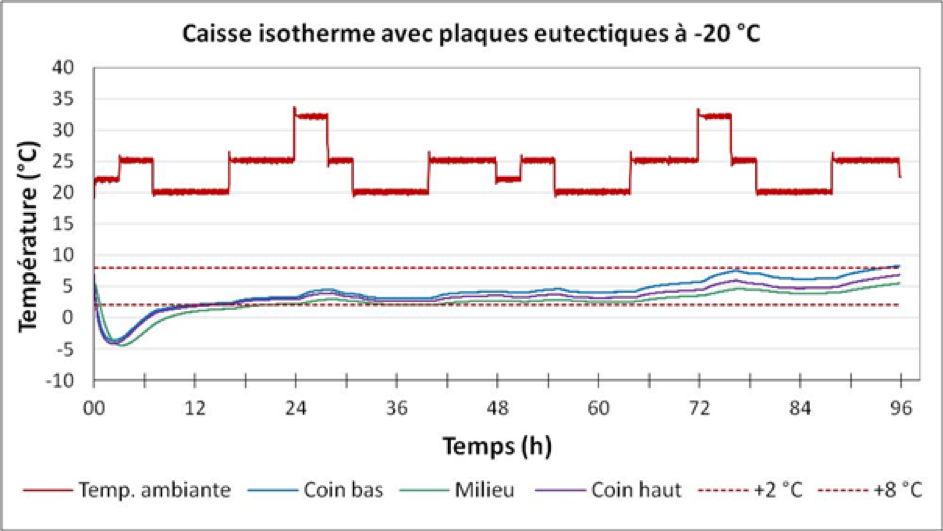
Figure 1:** Performance of the box with eutectic plates inserted at -20 °C
Eutectic Plates Inserted at -2 °C: In this test, the eutectic plates are frozen at -20 °C for at least 48 hours, then stabilised in another freezer at -2 °C for at least 24 hours before being inserted into the box. The recorded temperatures are presented in Figure 2. The three probes record temperatures above +2 °C throughout the test duration, thus avoiding any risk of freezing the products. The box maintains the products between +2 °C and +8 °C for 88 hours.
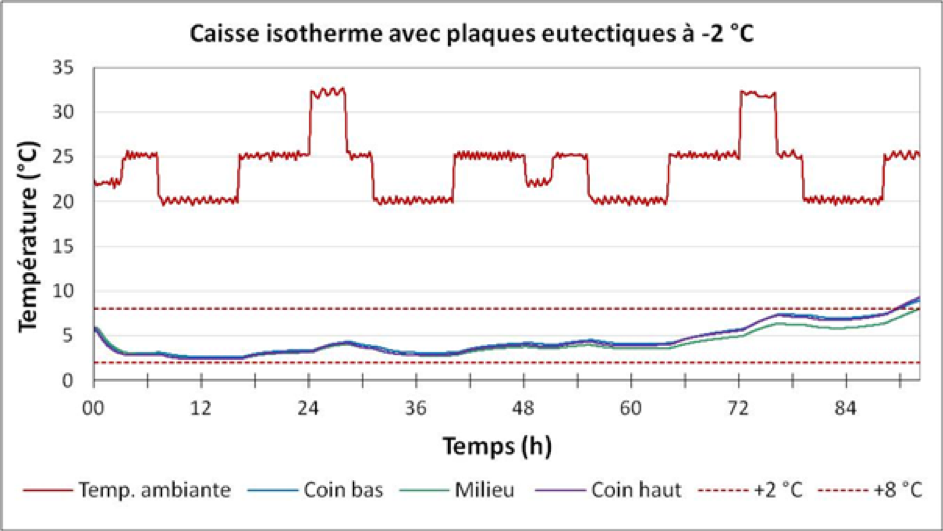
Figure 2:** Performance of the box with eutectic plates inserted at -2 °C
Protocol for Preparing Individual Eutectic Plates
Raising to -2 °C by Exposure to Ambient Temperature
Many users of eutectic plates do not have two distinct pieces of equipment, one for freezing below -15 °C and another for stabilisation at -2 °C. In this case, an operational mode based on an empirical method is proposed. This preparation mode consists of freezing the eutectic plates (generally at around -20 °C) and then leaving them at room temperature until their temperature reaches approximately -2 °C. The choice of the target -2 °C allows for the use of the latent phase of the eutectic solution at 0 °C and avoids the risk of freezing the products to be transported. The time for temperature rise is determined by the type of eutectic plate, as indicated in the tables below:
Temperature Rise Durations from -20 °C to -2 °C:
| Temperature Rise Duration from -20 °C to -2 °C | ||
| External Temperature | Thick Plate15 mm | Thick Plate 30 mm |
| +15 °C | 30 minutes | 60 minutes |
| +20 °C | 25 minutes | 50 minutes |
| +25 °C | 20 minutes | 40 minutes |
Temperature Rise Durations of the Same Eutectic Plates at an External Temperature of +20 °C:
| Duration to Rise to -2 °C at +20 °C | ||
| Freezing Temperature | Thick Plate 15 mm | Thick Plate 30 mm |
| -15 °C | 20 minutes | 40 minutes |
| -20 °C | 25 minutes | 50 minutes |
| -25 °C | 30 minutes | 60 minutes |
Test Protocol :
The tests are conducted on two types of plates with a 0 °C aqueous eutectic solution having the same length and width, but average net thicknesses of 30 mm and 15 mm respectively. The masses of the eutectic solution are 700 g and 350 g.
A probe is placed at the centre of the eutectic plate at the heart of the solution. To verify the repeatability of the results, the test is conducted simultaneously on three identical plates and repeated three times. The temperature probes are calibrated within the working range.
The instrumented eutectic plates are fully frozen and stabilised in the same freezer at -20 °C.
They are then placed at room temperature in a test chamber while avoiding exposure to mechanical ventilation airflow.
For each type of eutectic plate, tests are conducted under +15 °C, +20 °C, and +25 °C.
The temperature rise of the eutectic solution over time is recorded for each plate. The average temperature values are presented in Figures 3, 4 and 5 under +15 °C, +20 °C and +25 °C respectively.
Protocol for Preparing Eutectic Plates by Pallet
Many users (pharmaceutical laboratories, distributors, retailers etc.) use large quantities of thermal accumulators to ship products under controlled temperature. In this case, managing the preparation of thermal accumulators cannot be done using individual plates.
Tests have been conducted on a complete pallet of accumulators to determine an operational mode for preparing a large quantity of plates or eutectic trays.
Temperature Rise of a Pallet of Eutectic Plates
The objective of this test is to study the temperature rise to -2 °C of a complete pallet of boxes of eutectic plates by exposing it to ambient temperature.
Temperature probes are placed in the eutectic plates of peripheral boxes and at the centre of the pallet (unfavourable and favourable positions). The complete pallet is frozen and stabilised at -20 °C and then left at an ambient temperature of +20 °C.
This test shows the difficulty, if not the impossibility, of managing the temperature rise of a complete pallet of thermal accumulators by exposing it to ambient temperature. Significant discrepancies are recorded between the peripheral eutectic plates and those placed in the middle. The average duration of temperature rise from -20 °C to -2 °C varies from 2 hours for the peripheral boxes to 26 hours for the boxes placed at the centre of the pallet.
Stabilisation of a Pallet of Eutectic Trays in a Chamber at -2 °C
In some cases, several eutectic plates can be grouped in a tray. The test is conducted on a complete pallet of separated eutectic trays with supports allowing air circulation, as delivered by the supplier. The objective of this test is to study the preparation of a complete pallet of eutectic trays in two steps:
- The first consists of freezing the pallet in a chamber at a temperature below -20 °C.
- The second consists of stabilising this pallet in another chamber at -2 °C.
Temperature probes are placed in the peripheral eutectic plates and at the centre of the pallet to monitor the freezing and thermal stabilisation of the favourable and unfavourable points of the pallet. The evolution of the temperature of these representative points is illustrated in Figure 7.
It is observed that the trays cool from +20 °C to 0 °C and then freeze at 0 °C within less than 24 hours. After 36 hours, all eutectic trays are stabilised at the temperature of the freezing chamber (below -20 °C). The pallet is then placed in a second chamber at -2 °C where the trays are fully stabilised after 24 hours. A total duration of 72 hours is sufficient to freeze and then stabilise a complete pallet of perforated eutectic trays. In the absence of air circulation between the trays, the preparation time will be longer.
The appropriate operational mode for preparing a pallet of thermal accumulators consists of using two chambers, the first at around -20 °C for complete freezing of the plates (or trays) and the second at -2 °C for thermal stabilisation and storage.
Conclusion
The preparation of thermal accumulators is an important step in the proper use of isothermal boxes and securing the cold chain for health products. Thermal stabilisation and insertion of eutectic plates at -2 °C help avoid freezing of the products. The appropriate operational mode depends on the quantity of accumulators to be prepared and the means used.
After freezing, individual plates can be stabilised in a chamber at -2 °C or left at room temperature (between +15 °C and +20 °C) for a determined period based on the size of the plate, the freezing temperature and the ambient temperature.
After freezing, complete pallets of plates or eutectic trays require the use of thermal stabilisation in a chamber at -2 °C.
Authors: Abbes Kacimi, Director of Cold Chain Expertise, Sofrigam / David Stienne, Head of Ater Metrology Laboratory